ACCA Qualified Accountants
9 Powick Road, Birmingham B23 7NY
Equity Meaning in Business: UK Guide | House Of Accounts
If you run a business in the UK, you’ve almost certainly come across the word “equity” — on your balance sheet, in a conversation with an investor, or when your accountant talks about your company’s value. At House Of Accounts, we get asked what equity actually means more often than almost any other accounting term, so this guide breaks it down in plain English, with real examples.
What Does Equity Mean in Business?
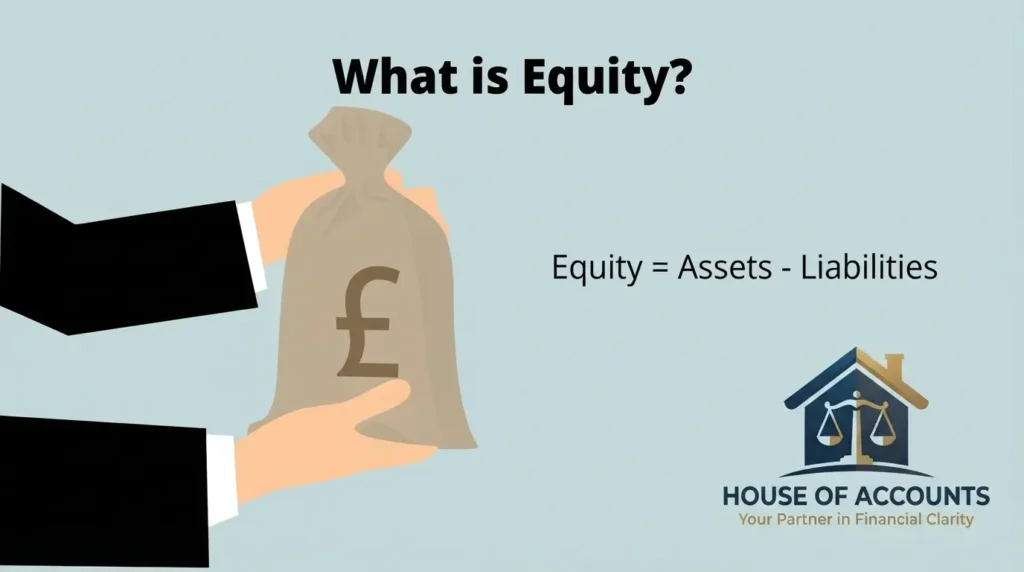
In the simplest terms, equity is the value of your business once you subtract everything it owes from everything it owns. If you sold every asset your company holds today and used the proceeds to pay off every debt and liability, whatever cash was left over would be your equity. It represents true ownership value — the portion of the business that genuinely belongs to you or your shareholders, free and clear.
Equity is sometimes called “net worth”, “owner’s equity”, or “shareholders’ funds”, depending on the context and the structure of your business. Whichever term your accountant uses, the underlying idea is the same: it’s what remains after liabilities are cleared.
The Equity Formula
Working out equity is straightforward once you understand the two numbers that feed into it:
- Equity = Total Assets − Total Liabilities
Assets include everything the business owns that has value — cash in the bank, equipment, stock, property, and money owed to you by customers. Liabilities include everything the business owes — loans, supplier invoices, credit cards, and tax bills.
For example, imagine a small Birmingham-based consultancy with £80,000 in total assets (cash, equipment, and unpaid invoices from clients) and £35,000 in total liabilities (a business loan and outstanding supplier bills). Its equity would be £80,000 − £35,000 = £45,000. That £45,000 is the value the owner could theoretically walk away with if everything was sold and every debt settled.
Types of Equity in a UK Business
Share Capital
For limited companies, equity is usually represented through shares. When a company issues shares to founders, employees, or outside investors, each share represents a small slice of ownership and, by extension, a claim on the company’s equity.
Retained Earnings
These are profits the business has made over time and chosen to keep within the company rather than pay out as dividends. Retained earnings build up equity year after year, which is why a consistently profitable business tends to see its equity grow steadily.
Private Equity
This refers to outside investment funds that buy a stake in a private company, usually with the goal of growing it and selling that stake later at a profit. It’s less common for very small businesses, but it becomes increasingly relevant as a company scales and looks to raise larger rounds of funding.
Negative Equity
If a business’s liabilities are greater than its assets, its equity is negative — meaning the business technically owes more than it owns. This is a serious warning sign for lenders, investors, and directors alike, and under UK insolvency law, directors can be held personally liable if they continue trading a company while aware it is insolvent.
Why Equity Matters for Your Business
Equity isn’t just an accounting figure buried in your annual accounts — it has real, practical consequences:
- Lenders and investors use it to judge financial health and decide whether to extend credit or invest.
- It determines how much of the business you actually own versus how much is financed by debt.
- It affects what you could realistically sell the business for.
- Growing equity over time is one of the clearest signs that a business is being run sustainably.
Equity vs Profit vs Cash — What's the Difference?
These three terms get confused constantly, so it’s worth being precise. Profit is what’s left after you subtract expenses from revenue over a period of time — it’s a flow, measured monthly or annually. Cash is simply the money sitting in your bank account right now. Equity is a cumulative, point-in-time snapshot of ownership value on your balance sheet. A business can be profitable this month while still having relatively low equity if it’s carrying significant debt, and it can have strong equity while being short on cash if its value is tied up in property or unpaid invoices.
Getting Your Business Equity Right
Understanding equity is one thing — keeping your books accurate enough that the figure actually means something is another. That’s where a dedicated accountant makes the difference. As part of our full range of accounting services, our ACCA Qualified accountants prepare accurate balance sheets, track your equity position, and explain what the numbers mean for your business in plain English — not jargon.
Frequently Asked Questions
Equity is what your business is truly worth after you subtract everything it owes from everything it owns. It's the value that genuinely belongs to the owner or shareholders.
No. Profit is income minus expenses over a period of time, while equity is a cumulative snapshot of ownership value at a single point in time, shown on the balance sheet.
Use the formula Equity = Total Assets − Total Liabilities. Add up everything your business owns, subtract everything it owes, and the result is your equity.
Negative equity means a business owes more than it owns. It's a red flag for lenders and investors, and directors of limited companies can face personal liability if they keep trading while aware the company is insolvent.
Equity (singular) usually refers to the ownership value of a single business or asset. Equities (plural) generally refers to shares or stocks traded across companies on the stock market.
Yes. Even without shares, a sole trader's equity is simply the value of their business assets minus their business liabilities — it's often referred to as "owner's equity" or "capital account".
Absolutely. Our ACCA Qualified accountants prepare and explain your balance sheet clearly, so you always know exactly where your business stands financially.
Ready to Start?
Don’t let confusing numbers or missed deadlines hold your business back. Get matched with a dedicated ACCA Qualified accountant at House Of Accounts and get clear, upfront pricing from day one.
Get in touch with our team today and let us take the accounting stress off your plate.
Contact Us to Book Your Free Consultation
📞 Call: +44 20 3386 1902
💬 WhatsApp: +44 7539 945628
✉️ Email: Info@housesofaccounts.co.uk
📍 Address: 9 Powick Road, Birmingham, B23 7NY, UK