ACCA Qualified Accountants
9 Powick Road, Birmingham B23 7NY

Opening Balance Meaning vs Closing Balance
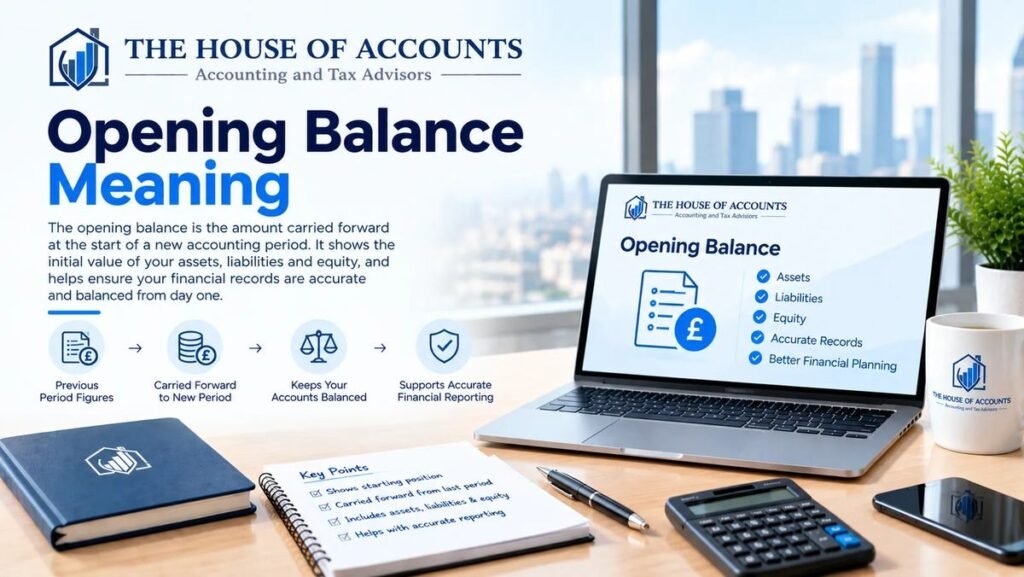
Opening and closing balances trip up a lot of people new to bookkeeping — House Of Accounts explains the opening balance meaning, how it connects to closing balances, and why getting it right matters.
What Is an Opening Balance?
An opening balance is the amount of money (or value, for a non-cash account) recorded in an account at the very start of a new accounting period — a month, quarter, or year. It’s not a new figure calculated from scratch; it’s simply the closing balance carried forward from the end of the previous period.
What Is a Closing Balance?
A closing balance is the amount left in an account at the end of an accounting period, after all transactions — income, expenses, payments, receipts — during that period have been recorded. This figure then becomes next period’s opening balance, continuing the chain forward.
How Opening and Closing Balances Connect
Opening Balance + Transactions During the Period = Closing Balance. This closing balance then becomes the next period’s opening balance. It’s a continuous thread running through your accounts — get an opening balance wrong, and every subsequent period’s figures will be wrong too.
A Simple Example
Say your business bank account has £5,000 at the end of March (the closing balance for March). That same £5,000 becomes your opening balance for April. If you then receive £3,000 in sales and pay out £2,000 in expenses during April, your closing balance for April is £5,000 + £3,000 − £2,000 = £6,000, which becomes May’s opening balance.
Where Opening Balances Matter Most
- Bank reconciliation — checking your books match your actual bank statement.
- Setting up new accounting software — entering the correct starting figures is essential.
- Year-end accounts — the opening balance for a new financial year must match the prior year’s closing figures exactly.
- VAT returns — opening and closing stock or debtor balances can affect certain calculations.
Common Opening Balance Mistakes
- Entering an opening balance that doesn’t match the actual prior closing balance.
- Forgetting to enter opening balances at all when switching accounting software.
- Double-counting transactions that straddle the boundary between two periods.
Opening Balances for Non-Cash Accounts
Opening and closing balances aren’t limited to bank accounts. Stock, debtors (money owed to you), and creditors (money you owe) all carry opening and closing balances too, and these directly affect calculations like cost of sales and working capital. An inaccurate opening stock figure, for example, will distort your gross profit calculation for the entire period, even if every other transaction was recorded correctly.
- Stock opening balances directly affect your cost of sales and gross profit calculation.
- Debtor and creditor opening balances feed into your working capital and cash flow forecasting.
- A stock count or debtor reconciliation at year-end confirms these opening balances are accurate going forward.
When your accountant prepares year-end accounts, one of the first checks they’ll run is confirming every opening balance ties back exactly to the prior year’s signed-off closing figures. Any mismatch here is treated as a priority to resolve before anything else, precisely because it can silently distort every other figure that follows — profit, tax due, and even the value the business appears to hold on paper.
For businesses just starting to use accounting software for the first time, the opening balance question often arises immediately — do you go back and enter every historical transaction, or simply enter a single opening balance figure and start fresh from today? In most cases, entering a single accurate opening balance and beginning clean record-keeping from that point forward is entirely acceptable, provided the opening figure itself is correct and properly documented.
Get Your Balances Right, Every Period
Accurate opening and closing balances are the foundation of reliable bookkeeping — exactly what our bookkeeping services ensure for every client, period after period.
Frequently Asked Questions
The opening balance is the amount recorded in an account at the start of a new period, carried forward directly from the previous period's closing balance.
Closing balance equals the opening balance plus all income or receipts during the period, minus all expenses or payments during that same period.
If they don't match, your accounts will be inconsistent going forward, and any discrepancy usually indicates a recording error that needs investigating.
Yes. When switching software, you must manually enter the correct opening balances to continue your accounts accurately from where the old system left off.
Yes, any account tracked over time — bank accounts, debtors, creditors, stock — has an opening balance at the start of each period.
Every subsequent calculation in that account will be incorrect until the error is identified and corrected, potentially affecting your entire set of accounts.
Yes. We ensure opening balances are accurate whenever setting up new bookkeeping systems or taking on new clients.
Ready to Start?
Don’t let confusing numbers or missed deadlines hold your business back. Get matched with a dedicated ACCA Qualified accountant at House Of Accounts and get clear, upfront pricing from day one.
Get in touch with our team today and let us take the accounting stress off your plate.
Contact Us to Book Your Free Consultation
📞 Call: +44 20 3386 1902
💬 WhatsApp: +44 7539 945628
✉️ Email: Info@housesofaccounts.co.uk
📍 Address: 9 Powick Road, Birmingham, B23 7NY, UK