ACCA Qualified Accountants
9 Powick Road, Birmingham B23 7NY
UK Accounting Overview: Full Guide for Businesses
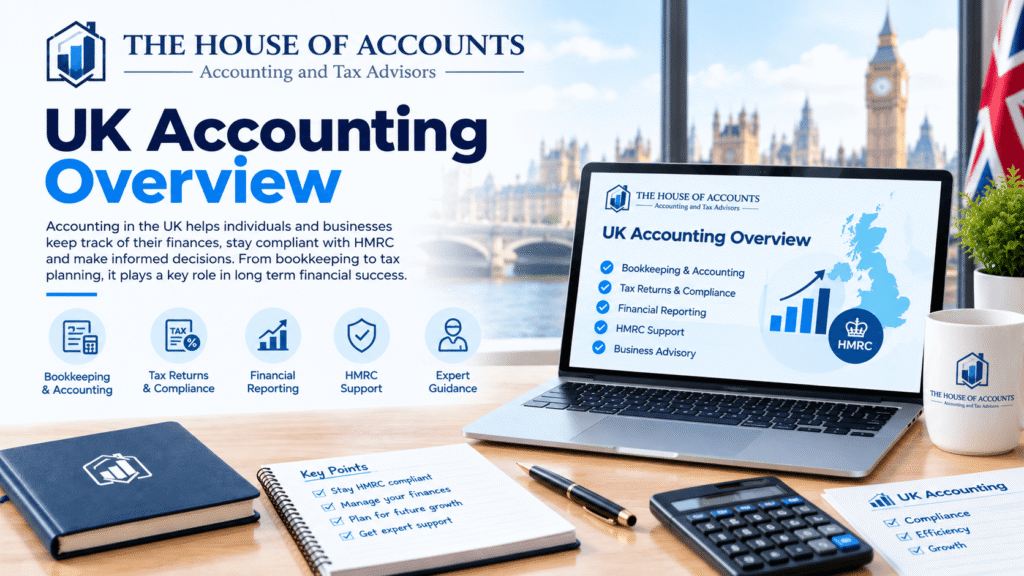
Whether you’re starting your first business or reviewing your current setup, understanding the basics of UK accounting helps you stay compliant and make better financial decisions. House Of Accounts breaks down the essentials.
The Building Blocks of UK Accounting
At its core, UK accounting is about accurately recording every transaction your business makes, then using those records to meet HMRC and Companies House reporting obligations while giving you a clear picture of your business’s financial health.
Bookkeeping: The Foundation
Bookkeeping is the day-to-day recording of income and expenses — every sale, every cost, every bank transaction. Accurate bookkeeping underpins everything else: your tax return, VAT filings, and management reports are only as reliable as the records they’re built on.
Tax Obligations Vary by Business Structure
- Sole traders file an annual Self Assessment tax return, declaring income and expenses.
- Limited companies file a Corporation Tax return (CT600) and annual statutory accounts.
- Partnerships file a partnership return alongside individual partners’ Self Assessment returns.
VAT: When It Applies
Any business — regardless of structure — must register for VAT once taxable turnover exceeds £90,000 in a rolling 12-month period, charging VAT on sales and reclaiming it on eligible business purchases, filing returns quarterly through Making Tax Digital-compatible software.
Payroll and PAYE
Businesses with employees — including company directors paying themselves a salary — must operate a PAYE scheme, deducting Income Tax and National Insurance correctly and reporting to HMRC in real time each pay period.
Key UK Accounting Deadlines
- 31 January — Self Assessment online filing and tax payment deadline.
- 9 months and 1 day after year-end — Corporation Tax payment deadline for limited companies.
- 12 months after year-end — Corporation Tax return filing deadline.
- Quarterly — VAT return and payment deadlines, for VAT-registered businesses.
Should You Do Your Own Accounting or Hire an Accountant?
Very simple, low-volume sole trader businesses can sometimes manage with a spreadsheet and careful record-keeping. But once VAT registration, payroll, or a limited company structure enters the picture, the complexity and penalty risk usually make a qualified accountant worthwhile — both for compliance and for the tax efficiency they can identify.
Digital Record-Keeping Requirements
Making Tax Digital is gradually reshaping how UK accounting works, requiring digital records and software-based submissions rather than manual or paper-based processes. It already applies to all VAT-registered businesses, and is rolling out to Income Tax Self Assessment for sole traders and landlords above set income thresholds, starting from April 2026 for those earning over £50,000 and extending to lower income bands in following years.
- MTD for VAT already applies to all VAT-registered businesses.
- MTD for Income Tax is rolling out in stages based on income thresholds from April 2026 onward.
- Getting comfortable with digital bookkeeping software now avoids a scramble when MTD requirements reach your income level.
Beyond compliance, digital record-keeping genuinely changes how useful your accounts are day to day. Instead of waiting until year-end to understand how the business has performed, cloud software with live bank feeds gives an almost real-time picture of profit, cash flow, and outstanding invoices — turning accounting from a once-a-year compliance exercise into an ongoing management tool that actively helps you run the business better throughout the year.
Ultimately, good UK accounting isn’t just about ticking compliance boxes — it’s about having numbers you can actually trust and act on. Whether that’s deciding when to hire, whether you can afford a new piece of equipment, or how much tax to set aside each month, the businesses that treat accounting as an ongoing habit rather than an annual chore tend to make noticeably better decisions than those scrambling to reconstruct a year’s activity at the last minute.
Get Full Support Across UK Accounting
From bookkeeping through to tax and payroll, House Of Accounts covers every part of UK accounting under one roof, with a dedicated ACCA Qualified accountant and clear, upfront pricing.
Frequently Asked Questions
It typically involves bookkeeping, VAT (if registered), an annual tax return (Self Assessment or Corporation Tax), and payroll if you have employees.
Yes. Sole traders file a Self Assessment return, while limited companies must file statutory annual accounts and a Corporation Tax return with more extensive reporting requirements.
Once your taxable turnover exceeds £90,000 in any rolling 12-month period, you must register within 30 days.
Yes, many businesses do this, though ensuring your bookkeeping is accurate throughout the year makes year-end filing far smoother.
HMRC and Companies House apply automatic penalties for late filing, which increase the longer the filing remains outstanding.
The core principles are the same, though e-commerce businesses often have additional considerations around VAT on cross-border sales and platform-reported income.
Yes. We provide bookkeeping, VAT, tax returns, and payroll under one service, with a dedicated ACCA Qualified accountant.
Ready to Start?
Don’t let confusing numbers or missed deadlines hold your business back. Get matched with a dedicated ACCA Qualified accountant at House Of Accounts and get clear, upfront pricing from day one.
Get in touch with our team today and let us take the accounting stress off your plate.
Contact Us to Book Your Free Consultation
📞 Call: +44 20 3386 1902
💬 WhatsApp: +44 7539 945628
✉️ Email: Info@housesofaccounts.co.uk
📍 Address: 9 Powick Road, Birmingham, B23 7NY, UK