ACCA Qualified Accountants
9 Powick Road, Birmingham B23 7NY
What Is a Unique Taxpayer Reference?
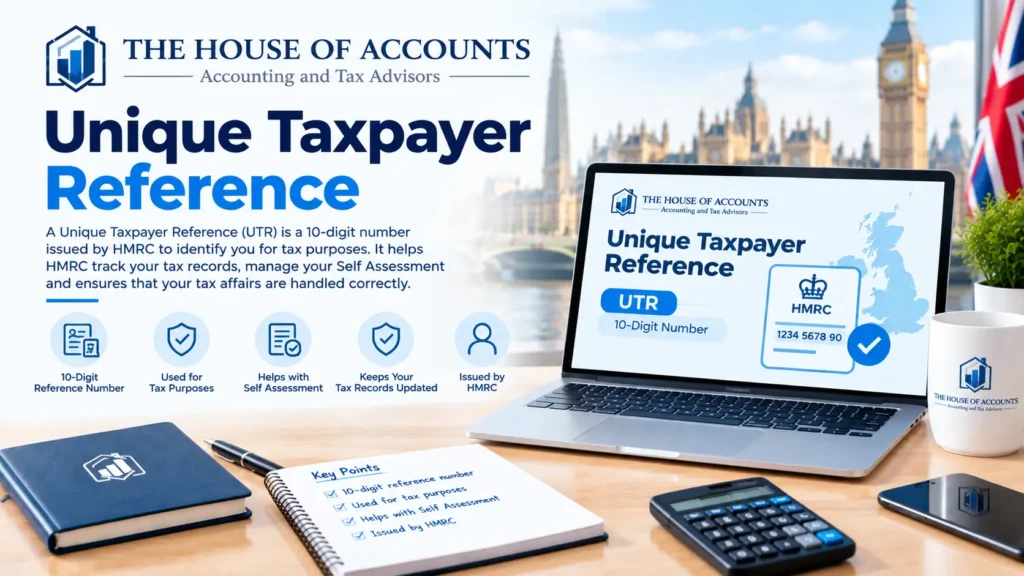
If you’ve registered for Self Assessment or set up a limited company, you’ll have been issued a Unique Taxpayer Reference. House Of Accounts explains what it’s for and how to find yours if you’ve misplaced it.
What Is a Unique Taxpayer Reference?
A Unique Taxpayer Reference (UTR) is a unique 10-digit number that HMRC assigns to identify a specific taxpayer — either an individual registered for Self Assessment or a limited company registered for Corporation Tax. It stays with you or your company permanently, and you’ll need it every time you interact with HMRC on tax matters.
Who Gets a UTR?
- Sole traders and self-employed individuals who register for Self Assessment.
- Company directors, once they register for Self Assessment personally.
- Limited companies, issued automatically when the company is registered with Companies House and HMRC.
- Partnerships, both the partnership itself and each individual partner.
Individual UTR vs Company UTR
These are two entirely separate numbers. Your personal UTR relates to your own Self Assessment obligations — even if you’re a company director. Your company’s UTR relates to its Corporation Tax obligations. A director will typically need both, depending on what they’re filing.
Where to Find Your UTR
- On your welcome letter from HMRC after registering for Self Assessment.
- On previous Self Assessment tax returns or payment reminders.
- In your HMRC online Personal Tax Account, under Self Assessment.
- For companies, on the Corporation Tax registration letter from HMRC, sent to the registered office address.
What Happens If You Lose Your UTR
Log into your HMRC online account to view it instantly, or call HMRC’s Self Assessment helpline, who can locate it using your personal details after security checks. It’s worth keeping a note of your UTR somewhere safe, since you’ll need it every filing season.
When You'll Need Your UTR
- Filing your annual Self Assessment tax return.
- Registering for other taxes, like VAT, linked to your existing record.
- Making payments to HMRC for Self Assessment or Corporation Tax.
- Communicating with HMRC by phone, where they’ll ask you to confirm it for identity verification.
UTR for Partnerships
Partnerships have their own layer of complexity around UTRs. The partnership itself is issued a UTR for filing the partnership tax return, which reports the total income and how it’s split between partners. Separately, each individual partner has their own personal UTR, used to declare their share of the partnership profit on their own Self Assessment return — meaning a partnership with three partners is actually dealing with four UTRs in total: one for the partnership and one for each partner.
- The partnership itself has its own UTR, distinct from any individual partner’s UTR.
- Each partner declares their share of profit under their own personal UTR.
- Both the partnership return and each partner’s individual return must be filed by the same 31 January deadline.
This multi-UTR structure is one of the more common sources of confusion when partnerships first register with HMRC, since it’s easy to assume one UTR should cover everyone. Getting the registrations set up correctly from the outset — with the right UTR used on the right return — avoids delays and rejected filings later, particularly in a partnership’s first year when everything is being registered for the first time simultaneously.
Whatever your situation, it’s worth treating your UTR with the same care as any other sensitive financial detail — never share it unnecessarily, and be cautious of unsolicited calls or emails claiming to be from HMRC that ask you to confirm it alongside other personal information. Genuine HMRC contact will never ask you to disclose your full UTR alongside banking details over an unexpected phone call or text message.
Get Your UTR Set Up Correctly
If you need help registering for Self Assessment or setting up your Corporation Tax UTR, our accounting services handle the registration process and everything that follows.
Frequently Asked Questions
HMRC uses your UTR to identify you or your company for Self Assessment or Corporation Tax purposes, required whenever you file a return or make a related payment.
You're issued a UTR automatically when you register for Self Assessment as an individual, or when your limited company is registered with HMRC for Corporation Tax.
Check your HMRC welcome letter, past tax returns, or log into your HMRC online Personal Tax Account, where it's displayed under Self Assessment.
Yes. Your personal UTR covers your individual Self Assessment obligations, while your limited company has its own, separate UTR for Corporation Tax.
After registering for Self Assessment, HMRC typically issues your UTR within about 10 working days, sent by post.
No. Your UTR is required to file a Self Assessment or Corporation Tax return, so you must register and receive it beforehand.
Yes. We handle Self Assessment and Corporation Tax registration for clients, including obtaining your UTR.
Ready to Start?
Don’t let confusing numbers or missed deadlines hold your business back. Get matched with a dedicated ACCA Qualified accountant at House Of Accounts and get clear, upfront pricing from day one.
Get in touch with our team today and let us take the accounting stress off your plate.
Contact Us to Book Your Free Consultation
📞 Call: +44 20 3386 1902
💬 WhatsApp: +44 7539 945628
✉️ Email: Info@housesofaccounts.co.uk
📍 Address: 9 Powick Road, Birmingham, B23 7NY, UK