Sole traders: keep your records for at least 5 years after the 31 January Self Assessment deadline for the tax year. Limited companies: keep records for 6 years from the end of the last company financial year they relate to. VAT records: generally at least 6 years. Payroll records: 3 years from the end of the tax year. Some situations mean keeping them longer.
How long to keep business records in the UK depends on how your business is set up. If you are self-employed, HMRC says you must keep records for at least 5 years after the 31 January submission deadline. A limited company must keep records for 6 years from the end of the last financial year they relate to.
These are minimums. Below, the team at House Of Accounts sets out each period by record type, how to count it, and when to keep records longer.
Retention periods at a glance
Minimum periods for the main record types, with the official basis:
| Record type | Sole trader (self-employed) | Limited company | Basis |
|---|---|---|---|
| Income and expense records for tax | At least 5 years after the 31 January deadline for the tax year | 6 years from the end of the last financial year they relate to | GOV.UK self-employed records guidance; GOV.UK company and accounting records guidance |
| Accounting records under company law | Not applicable | Private company: 3 years from the date they are made (public company: 6 years) | Companies Act 2006, section 388(4) |
| VAT records (if VAT-registered) | Generally at least 6 years | Generally at least 6 years | HMRC VAT Notice 700/21 |
| Payroll (PAYE) records (if you employ staff) | 3 years from the end of the tax year they relate to | 3 years from the end of the tax year they relate to | GOV.UK PAYE record-keeping guidance |
Where two rules apply to the same record, follow the longer one.
How long do sole traders need to keep records?
Sole traders must keep their records for at least 5 years after the 31 January submission deadline for the tax year. The clock starts at the online filing deadline, not at the end of the tax year and not on the day you filed.
Worked example: for the 2025 to 2026 tax year, the online deadline is 31 January 2027 (a Sunday). Keep that year's records until at least the end of January 2032.
There is one exception. If you send your tax return more than 4 years after the deadline, you must keep the records for 15 months after you send the return.
HMRC can use these records to check you pay the right tax. The official wording is on GOV.UK: how long to keep your records.
How long must a limited company keep records?
A limited company must keep records for 6 years from the end of the last company financial year they relate to. That is the GOV.UK rule for company and accounting records.
Company law sets a separate minimum. Under section 388 of the Companies Act 2006, a private company must preserve its accounting records for 3 years from the date they are made. A public company must keep them for 6 years.
Which wins? For a private company, the 6-year tax period is longer, so follow that one.
GOV.UK says a company must keep records longer than 6 years if:
- they show a transaction that covers more than one of the company's accounting periods
- the company has bought something it expects to last more than 6 years, such as equipment or machinery
- you sent your Company Tax Return late
- HMRC has started a compliance check into your Company Tax Return
Records do not have to stay at the registered office. If you keep them somewhere else, you must tell Companies House. GOV.UK also warns that HMRC can fine a company £3,000, or a director can be disqualified, if the company does not keep accounting records.
How long to keep VAT and payroll records
VAT records
HMRC VAT Notice 700/21 says that, generally, you must keep business records for VAT purposes for at least 6 years. HMRC may allow a shorter period for some records, but ask first rather than assume.
Some documents must be kept in their original form. The notice gives the C79 import VAT certificate as an example. VAT invoices you issue also need the right details on them; see our guide to invoice numbering rules.
Payroll (PAYE) records
Employers must keep payroll records for 3 years from the end of the tax year they relate to. These include pay and deductions, reports and payments to HMRC, leave and sickness absence, tax code notices, taxable expenses or benefits, and Payroll Giving Scheme documents.
If you do not keep full payroll records, HMRC may estimate what you owe and charge a penalty of up to £3,000. Separate rules apply to records that prove minimum wage payments and statutory leave and holiday pay.
When should you keep records longer?
Keep records past the minimum period if any of these apply:
- HMRC has opened a check or enquiry. Keep everything relevant until it closes.
- You filed late. A late Company Tax Return extends the company period; a Self Assessment return sent more than 4 years late means keeping records for 15 months after sending it.
- You still own a long-life asset, such as machinery expected to last more than 6 years (companies).
- A transaction spans several accounting periods, such as a multi-year contract.
- Another law sets a different period. Contracts, employment law and UK GDPR have their own rules; take legal advice on those.
Can you keep scanned or digital records?
Yes, in most cases. HMRC does not require records to be kept in a set way, and most bookkeeping and computer systems meet the requirement. For VAT, if a scanned image keeps all the detail needed, you do not need to keep the original invoice unless you need it for another purpose.
There are limits. Some records, such as the C79 certificate, must be kept in their original form. If you are within Making Tax Digital for VAT, records that form part of your electronic account must be kept digitally in functional compatible software.
Before shredding originals, check each scan is readable and backed up.
A simple annual archive routine
A short routine soon after you file your return or accounts makes it clear what can go.
- Close the year. Put the filed year's records into one dated folder.
- Label the destroy date using the table above.
- Check for triggers from the list above; if one applies, push the date back.
- Test your backups by opening a sample of digital files.
- Destroy securely. Shred paper and permanently delete digital files holding personal data.
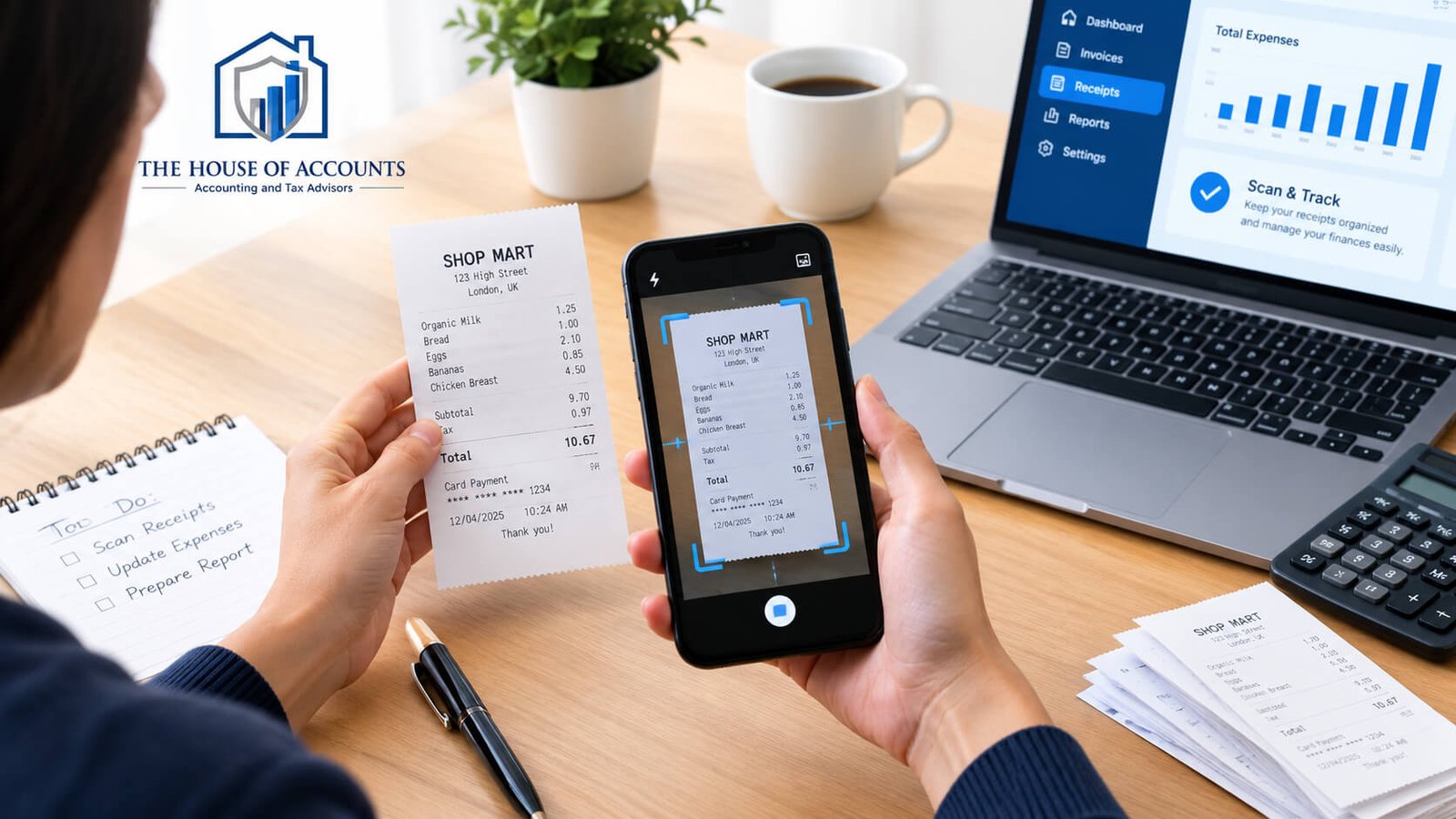
If you would rather not do this yourself, our day-to-day bookkeeping support keeps your records organised through the year, so the yearly clear-out is straightforward. Fees are quoted after a short scope call, with all costs listed upfront.
What we cannot advise on
We are accountants, not solicitors. For contracts, employment files or personal data under UK GDPR, speak to a solicitor or data protection specialist.
Frequently asked questions
How long do I need to keep business records for tax?
If you are self-employed, keep records for at least 5 years after the 31 January Self Assessment deadline for the tax year. A limited company must keep records for 6 years from the end of the last financial year they relate to. VAT records are generally kept for at least 6 years, and payroll records for 3 years.
Can I keep scanned copies instead of paper receipts?
Usually, yes. HMRC does not require records in a set format. For VAT, a scanned image that keeps all the required detail means you do not need the original invoice, unless you need it for another purpose. Some documents, such as the C79 import VAT certificate, must be kept in their original form.
How long must a limited company keep its accounting records?
For tax, 6 years from the end of the last company financial year they relate to, or longer in some cases. Under the Companies Act 2006, a private company must keep accounting records for at least 3 years from the date they are made. Follow the longer, 6-year tax period.
What if HMRC asks about a year and I no longer have the records?
GOV.UK says that if self-employed records are lost, stolen or destroyed, you must do your best to provide figures. You can use estimated or provisional figures and tell HMRC which type you used. If you receive an HMRC letter about missing records, get advice before you reply.
Not sure what you can throw away?
If you have a box of old receipts or a folder of statements and are unsure whether they can go, ask us a question. Tell us the record type, the year and your business structure, and we will tell you whether it is past its minimum retention period.
This article was researched and drafted with AI assistance, then fact-checked against GOV.UK and HMRC guidance and edited by the House Of Accounts team.