
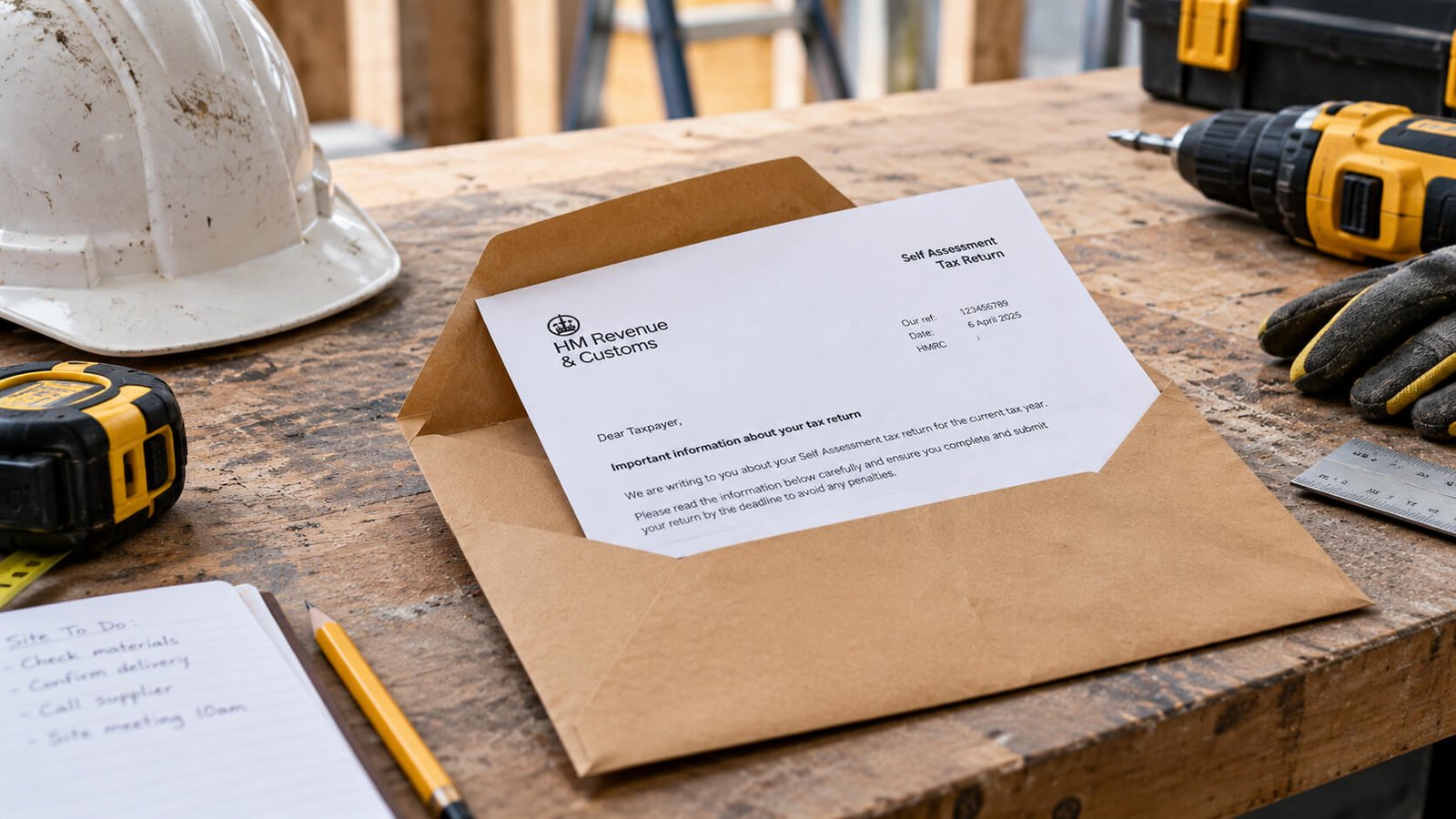
CIS late filing penalties start at £100 the day after a monthly return is due. HMRC adds £200 more at 2 months and at least £300 more at 6 months. At 12 months it charges a further penalty that depends on why the return is late, and each monthly return, including a nil return, is penalised separately.
Your CIS300 monthly return is due by the 19th of the month after the tax month ends. The tax month runs from the 6th of one month to the 5th of the next. The table below follows the HMRC factsheet CCFS18b and HMRC's guidance on filing monthly returns.
| How late | Penalty for that return | How it works |
|---|---|---|
| 1 day | £100 | Fixed and automatic |
| 2 months | £200 more | Fixed, added to the first penalty |
| 6 months | £300 or 5% of the CIS deductions on the return, whichever is higher | Added on top |
| 12 months | £300 or 5% of the deductions, whichever is higher, or more if HMRC finds the delay was deliberate | Depends on why the return is late |
Some online guides quote £500 at 6 months. HMRC's own figure is £300 or 5% of the deductions on the return, whichever is higher. So a return with no deductions that is 12 months late, where the delay was not deliberate, costs at least £900: £100 + £200 + £300 + £300.
For help beyond CIS, see the services a construction business needs.
Why does each missed month count as a separate penalty?
Because every CIS300 return is a separate obligation with its own deadline. HMRC says you should file a return every month, even in a month when you made no payments to subcontractors. If you paid no one, you either file a nil return or make an inactivity request.
This is where costs grow unnoticed. A nil return is still a return, with the same deadline and the same penalties. Every month without a nil return or an inactivity request starts its own penalty clock.
Worked example: three missed nil returns
Our calculation for an established contractor who pays no subcontractors from 6 December 2025 to 5 March 2026, files nothing for those three tax months, then sends all three nil returns on Friday 25 September 2026.
| Tax month | Return due | 1 day | 2 months | 6 months | Total |
|---|---|---|---|---|---|
| 6 Dec 2025 to 5 Jan 2026 | Mon 19 Jan 2026 | £100 | £200 | £300 | £600 |
| 6 Jan to 5 Feb 2026 | Thu 19 Feb 2026 | £100 | £200 | £300 | £600 |
| 6 Feb to 5 Mar 2026 | Thu 19 Mar 2026 | £100 | £200 | £300 | £600 |
| All three returns | £300 | £600 | £900 | £1,800 |
No deductions were due, so 5% of the deductions is nil and the £300 minimum applies at 6 months. Had the returns been left past the 12-month point, each would pick up at least another £300, taking the total to at least £2,700. Filing three nil returns on time, or making an inactivity request, would have cost nothing.
For a contractor's first return, where earlier returns are also late, HMRC says the £100 and £200 fixed penalties may be capped at a maximum of £3,000. This applies to returns due on or after 19 November 2011; later periods are not capped.
When capped, HMRC normally charges 5% of the deductions at 6 and 12 months, even if under £300 (not where a return was deliberately withheld).
What penalties apply after 12 months?
At 12 months, the penalty depends on why the return is late. If HMRC decides you deliberately withheld information, it charges a percentage of the deductions, with a minimum:
| Behaviour | Disclosure | Where deductions are due | Where no deductions are due |
|---|---|---|---|
| Not deliberate | n/a | 5% or £300, whichever is higher | £300 |
| Deliberate | Unprompted | 20% to 70%, minimum £1,500 | £1,500 |
| Deliberate | Prompted | 35% to 70%, minimum £1,500 | £1,500 |
| Deliberate and concealed | Unprompted | 30% to 100%, minimum £3,000 | £3,000 |
| Deliberate and concealed | Prompted | 50% to 100%, minimum £3,000 | £3,000 |
Within each range, HMRC reduces the percentage for the quality of your disclosure: up to 30% for telling, up to 40% for helping and up to 30% for giving access to records.
If HMRC says your behaviour was deliberate, take specialist tax investigation advice before you reply. That is outside routine CIS compliance work.
Is late payment penalised separately?
Yes. Deductions are due to HMRC by the 22nd of the month, or the 19th if you pay by post, and HMRC says you may be charged interest and penalties if you pay late.
How to appeal a CIS late filing penalty
You can appeal within 30 days of the date on the penalty notice, online or in writing. You cannot appeal over the phone. Work through these steps:
- Check the notice. Confirm the tax month, due date and arrival date. If HMRC's records are wrong, include your submission receipt.
- Choose your grounds. Either the penalty is wrong, or you had a reasonable excuse (see below).
- Gather evidence. Dates, receipts, error messages and supporting letters.
- File anything still missing. HMRC says you must send your return as soon as you are able to.
- Appeal within 30 days. Use HMRC's online service, where you can also track the appeal, or write to HMRC quoting your UTR and the payment reference on the notice.
- If HMRC does not agree. Within 30 days you can send new information to the officer, ask for a review by an officer not involved in the matter, or have an independent tribunal hear the appeal. Alternative Dispute Resolution may also be available.

Missed the 30 days? You can still contact HMRC, but must give a reason.
No one can guarantee that an appeal will succeed: the decision rests with HMRC or the tribunal. House Of Accounts' team can check a notice against your filing records, tell you whether there are grounds, and draft the appeal.
What counts as a reasonable excuse?
A reasonable excuse is something that stopped you meeting the deadline even though you took reasonable care. These are HMRC's own examples:
| May count | Will not count |
|---|---|
| A partner or close relative died shortly before the deadline | Your payment failed because you did not have enough money |
| An unexpected hospital stay | You found HMRC's online system too difficult to use |
| A serious or life-threatening illness | You did not get a reminder from HMRC |
| Your computer or software failed while you were preparing the return | You made a mistake on your return |
| Postal delays you could not have predicted | |
| Someone else was meant to file and did not, but only if you took reasonable care |
How do you stop CIS penalties happening again?
File a return every month, including nil months, or tell HMRC you have temporarily stopped using subcontractors. A simple routine helps:
- Diary the 19th for the return and the 22nd for payment, every month.
- File a nil return in any month with no subcontractor payments, unless you have made an inactivity request.
- Keep the submission receipt for each return.
- Open HMRC letters promptly, because the 30-day appeal window runs from the date on the notice.
Our CIS return deadline guide lists every due date for the year. If you would rather not track this yourself, we offer monthly CIS returns handled for you.
Frequently asked questions
What happens if I file a CIS return one day late?
HMRC charges a fixed £100 penalty for that return. The charge is automatic, so it applies even if the return arrives the next day and even if it is a nil return. If the return is still outstanding at 2 months, £200 more is added, and further penalties follow at 6 and 12 months.
Can I appeal a CIS penalty?
Yes. You can appeal within 30 days of the date on the penalty notice, using HMRC's online service or by writing to HMRC with your UTR and the payment reference. You need to show that the penalty is wrong or that you had a reasonable excuse. You cannot appeal over the phone.
Do penalties apply to nil returns?
Yes. HMRC expects a return every month, even when you paid no subcontractors, unless you have made an inactivity request. A late nil return gets the same £100, £200 and £300 penalties as any other return. With no deductions on it, the 6-month penalty is the £300 minimum.
What is a tax-geared penalty?
It is a penalty worked out as a percentage of the tax involved rather than a fixed sum. For CIS, the 6- and 12-month penalties can be 5% of the deductions on the return. Where HMRC finds deliberate and concealed withholding, the 12-month penalty can reach 100%, with a £3,000 minimum.
Got a CIS penalty notice?
Send us the notice and the dates you filed. We will check whether an appeal is worth making and what needs filing next. To start, contact House Of Accounts. Fees are quoted after a short scope call, with all costs listed upfront.
This article was researched and drafted with AI assistance, then fact-checked against GOV.UK and HMRC guidance and edited by the House Of Accounts team.