ACCA Qualified Accountants
9 Powick Road, Birmingham B23 7NY
How to Report Freelance Income to HMRC
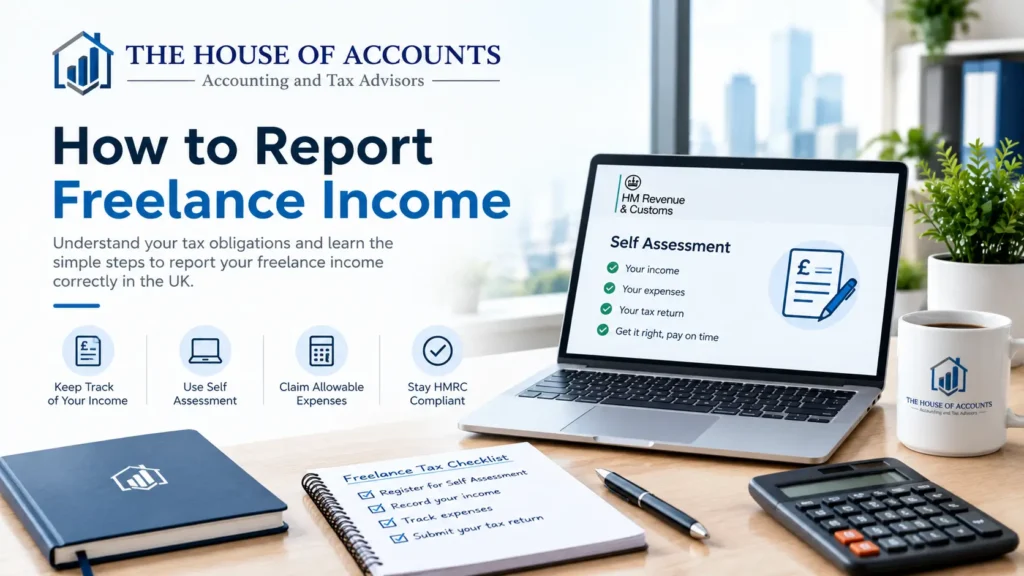
Freelancing gives you flexibility, but it also puts the responsibility for reporting your income squarely on you. House Of Accounts walks through exactly how to report freelance income to HMRC, step by step.
Step 1: Determine If You Need to Register
If your freelance income exceeds the £1,000 trading allowance in a tax year, you need to register for Self Assessment. Below £1,000, the trading allowance covers your income tax-free and no registration is required, though you can still choose to register voluntarily.
Step 2: Register for Self Assessment
Register with HMRC online by 5 October following the end of the tax year in which you started freelancing. For example, if you started freelancing in the 2026/27 tax year, you’d need to register by 5 October 2027. HMRC will then set up your Self Assessment account and issue your Unique Taxpayer Reference (UTR).
Step 3: Keep Accurate Records
- All income received, including invoices raised and payments received.
- Every business expense, with receipts or digital records kept for at least five years.
- Bank statements for any account used for freelance income.
- Records of any freelance income reported to HMRC directly by platforms you work through.
Step 4: Claim Allowable Expenses
- Equipment and software used wholly for your freelance work.
- A proportion of home office costs if you work from home.
- Travel costs for business purposes, excluding ordinary commuting.
- Professional subscriptions, insurance, and marketing costs.
Alternatively, if your income is under £1,000, you can simply apply the trading allowance as a flat deduction instead of tracking actual expenses — useful if your real costs are lower than £1,000.
Step 5: File Your Self Assessment Return
Complete your Self Assessment return online by 31 January following the end of the relevant tax year, declaring your total freelance income and allowable expenses. Any tax owed is also due by this date, alongside any Payments on Account required toward the following year’s tax bill.
Do Freelance Platforms Report to HMRC?
Since January 2024, digital platforms — including freelance marketplaces, gig economy apps, and online selling platforms — are required to report seller and worker income directly to HMRC. This makes accurate self-reporting more important than ever, since HMRC can cross-reference platform data against your tax return.
Freelancing Alongside Full-Time Employment
Many freelancers also hold a full-time PAYE job, and it’s a common misconception that this means freelance income doesn’t need declaring. It absolutely does — once it exceeds £1,000, you must register for Self Assessment regardless of your employment status, and your freelance profit is simply added on top of your employment income when calculating your overall tax band and liability.
- Freelance income is added to your employment income for tax band purposes, potentially pushing you into a higher rate.
- Your PAYE tax code doesn’t automatically account for freelance income — Self Assessment handles that separately.
- Keeping the two income streams clearly separated in your records makes year-end filing far smoother.
One area that catches people out is Student Loan repayments, which are calculated on total income across both employment and self-employment combined, not each source separately. If you have a student loan and your combined income crosses the repayment threshold, Self Assessment will calculate the correct repayment due on your freelance profit even though your employer is already deducting repayments from your PAYE salary — so budgeting for this alongside your tax bill matters.
Keeping a simple spreadsheet or app throughout the year that separates freelance invoices from employment payslips makes January far less stressful. Many freelancers who leave everything until the deadline end up scrambling through bank statements trying to reconstruct months of income and expenses from memory — a habit that almost always results in missed deductions and a higher tax bill than necessary.
Get Your Freelance Tax Right
Reporting freelance income correctly — and claiming every expense you’re entitled to — is exactly what our Self Assessment services handle for freelancers across the UK.
Frequently Asked Questions
Yes, if your freelance income exceeds the £1,000 trading allowance in a tax year, you must register for Self Assessment by 5 October following that tax year.
You can claim costs wholly and exclusively for your freelance work, including equipment, software, a proportion of home office costs, and business travel.
Your Self Assessment return and any tax owed is due by 31 January following the end of the relevant tax year.
Yes. Since January 2024, digital platforms are legally required to report seller and worker income data directly to HMRC.
The £1,000 trading allowance covers this tax-free, and you generally don't need to register or file a return for that income alone.
Yes, self-employed individuals typically pay Class 4 National Insurance on profits above a certain threshold, calculated through Self Assessment.
Yes. We register, prepare, and file Self Assessment returns for freelancers, ensuring every allowable expense is claimed correctly.
Ready to Start?
Don’t let confusing numbers or missed deadlines hold your business back. Get matched with a dedicated ACCA Qualified accountant at House Of Accounts and get clear, upfront pricing from day one.
Get in touch with our team today and let us take the accounting stress off your plate.
Contact Us to Book Your Free Consultation
📞 Call: +44 20 3386 1902
💬 WhatsApp: +44 7539 945628
✉️ Email: Info@housesofaccounts.co.uk
📍 Address: 9 Powick Road, Birmingham, B23 7NY, UK