ACCA Qualified Accountants
9 Powick Road, Birmingham B23 7NY
What Is a PAYE Reference Number? (UK Guide)
If you’re setting up payroll for the first time, you’ll come across the term PAYE reference number early on. House Of Accounts explains exactly what it is and where employers can find theirs.
What Is a PAYE Reference Number?
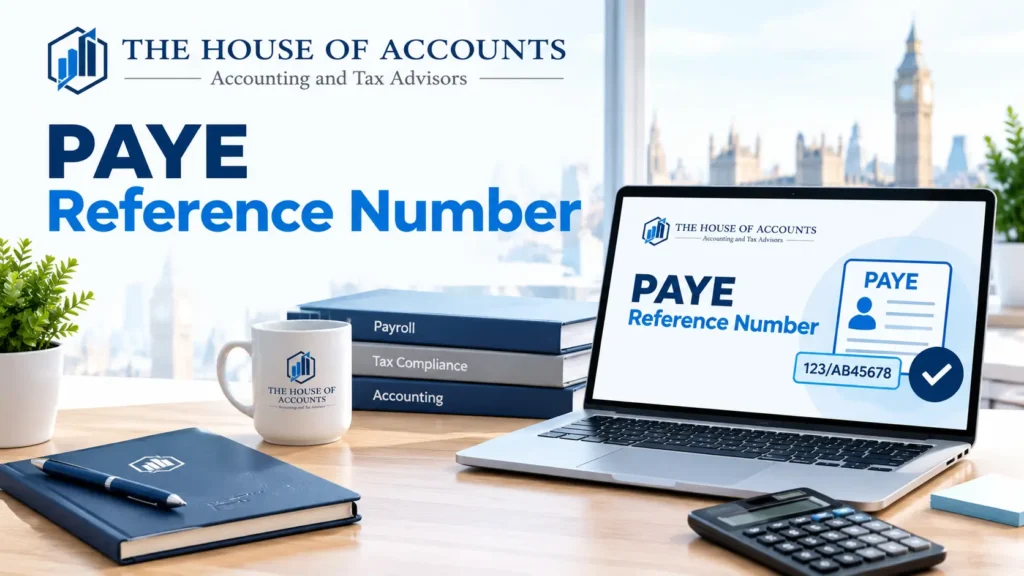
A PAYE reference number (sometimes called an Employer PAYE Reference) is a unique identifier HMRC assigns to every business that registers to run payroll. It usually appears in the format 123/AB45678, with the first part identifying the tax office and the second part identifying your specific business.
Why Employers Need a PAYE Reference
- It identifies your business to HMRC for all payroll-related reporting.
- It’s required on payslips, P60s, and P45s issued to employees.
- HMRC uses it to match your Real Time Information (RTI) submissions to the correct employer record.
- It’s needed when contacting HMRC about payroll queries.
How to Get a PAYE Reference Number
You register as an employer with HMRC before your first payday, either online or through your accountant. HMRC typically issues your PAYE reference within about 5 working days, though it can take up to 15 working days during busier periods. You cannot run payroll or pay staff through PAYE until you have it.
Where to Find Your PAYE Reference Once Issued
- On the registration confirmation letter HMRC sends after you register as an employer.
- On any payslip or P60 your business has issued.
- In your HMRC online business tax account, under PAYE for employers.
- On correspondence from HMRC relating to payroll.
PAYE Reference vs Accounts Office Reference
These are often confused but serve different purposes. Your PAYE reference identifies you for reporting purposes, while your separate Accounts Office reference is used specifically when making PAYE payments to HMRC — both are needed to run payroll correctly.
Do You Need to Register for PAYE?
Any business paying an employee (including a director paying themselves a salary) above the Lower Earnings Limit, or providing employee benefits, generally needs to register for PAYE — even a one-person limited company with a single director usually needs a PAYE scheme.
What If You Don't Have Employees Yet?
If you’re a sole director with no employees and pay yourself below the Lower Earnings Limit, you may not need to register for PAYE immediately — though most directors still register early, since it’s needed the moment you want to take a salary above that threshold, and setting it up in advance avoids delays when you’re ready to start paying yourself formally.
- Below the Lower Earnings Limit, PAYE registration isn’t always immediately required.
- Registering early avoids delays once you’re ready to start taking a salary.
- An accountant can advise on the most tax-efficient salary level for a sole director in year one.
Once you do take on your first employee, PAYE registration becomes non-negotiable, and it needs to happen before the first payday, not after. HMRC recommends registering as soon as you know you’ll be employing someone, since processing can take a couple of weeks — leaving it until the week before your first payroll run risks paying staff late or running an informal, non-compliant payroll in the meantime.
It’s also worth noting that your PAYE reference stays with your business for as long as the PAYE scheme remains open, even through changes in staff numbers or business address, so there’s no need to re-register each time your circumstances change. If you do need to close your PAYE scheme entirely — for example, if the business stops employing anyone — this needs to be formally notified to HMRC rather than simply left inactive.
Set Up Your PAYE Scheme Correctly
Registering for PAYE and running payroll compliantly is part of our payroll services, so your PAYE reference, RTI submissions, and payslips are all handled correctly from day one.
Frequently Asked Questions
It typically follows the format 123/AB45678 — a three-digit tax office code followed by a unique reference for your business.
You register as an employer with HMRC before your first payday, and HMRC issues your PAYE reference, usually within 5 to 15 working days.
Check your HMRC registration letter, any payslip or P60 issued, or your HMRC online business tax account.
The PAYE reference identifies your business for reporting purposes, while the Accounts Office reference is used specifically when making PAYE payments to HMRC.
Generally yes, if the director takes a salary above the Lower Earnings Limit, the company needs to register for PAYE like any other employer.
HMRC typically issues a PAYE reference within about 5 working days, though it can take up to 15 working days during busier periods.
Yes. We handle PAYE registration and ongoing payroll processing as part of our full accounting services.
Ready to Start?
Don’t let confusing numbers or missed deadlines hold your business back. Get matched with a dedicated ACCA Qualified accountant at House Of Accounts and get clear, upfront pricing from day one.
Get in touch with our team today and let us take the accounting stress off your plate.
Contact Us to Book Your Free Consultation
📞 Call: +44 20 3386 1902
💬 WhatsApp: +44 7539 945628
✉️ Email: Info@housesofaccounts.co.uk
📍 Address: 9 Powick Road, Birmingham, B23 7NY, UK