ACCA Qualified Accountants
9 Powick Road, Birmingham B23 7NY
UK Tax Calculator: Estimate Your Take-Home Pay
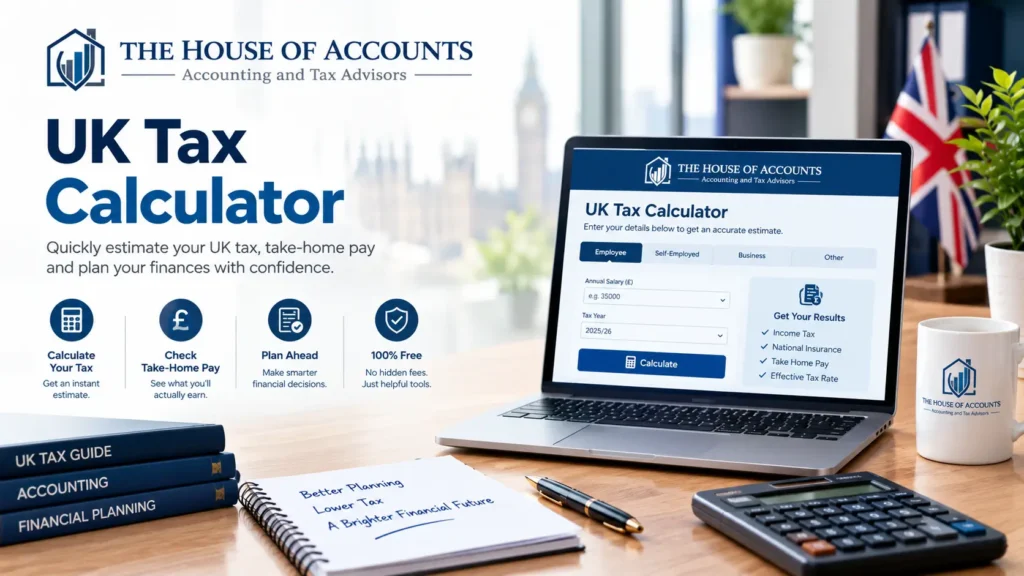
Understanding exactly how much of your salary you’ll actually keep isn’t always obvious — a House Of Accounts UK tax calculator does the maths instantly, but it helps to understand what’s happening behind the numbers.
What Does a UK Tax Calculator Work Out?
A UK tax calculator takes your gross salary and applies the current tax year’s Personal Allowance, Income Tax bands, and National Insurance rates to show you exactly how much you’ll take home each month or year.
2026/27 Income Tax Bands
- Personal Allowance: £12,570 — tax-free.
- Basic rate: 20% on income from £12,571 to £50,270.
- Higher rate: 40% on income from £50,271 to £125,140.
- Additional rate: 45% on income above £125,140.
National Insurance Rates (2026/27)
Employee National Insurance is charged at 8% on earnings between £242 and £967 per week, and 2% on earnings above that upper limit. These thresholds align closely with the Income Tax Personal Allowance and higher-rate threshold.
The £100,000 Personal Allowance Taper
Once your adjusted net income exceeds £100,000, your Personal Allowance reduces by £1 for every £2 earned above that threshold, disappearing entirely at £125,140. This creates an effective marginal tax rate of around 60% on income within that band — a detail many manual calculations miss.
A Worked Example
On a £45,000 salary, the first £12,570 is tax-free, the remaining £32,430 is taxed at 20% basic rate (£6,486 Income Tax), and National Insurance applies at 8% on earnings above the primary threshold. After tax and NI, take-home pay works out to roughly £3,000 a month — the exact figure depends on pension contributions and tax code.
Why Use a Calculator Instead of Estimating
- Avoids under- or over-estimating your actual disposable income.
- Accounts for the Personal Allowance taper automatically at higher incomes.
- Helps with budgeting for salary negotiations or a career change.
- Useful for company directors deciding between salary and dividends.
Tax Codes and How They Affect the Calculation
Your tax code tells your employer how much tax-free Personal Allowance to apply, and an incorrect one can throw off any calculator’s result significantly. The standard code for 2026/27 is 1257L, reflecting the £12,570 allowance. Codes like BR (basic rate, no allowance), 0T (no allowance, progressive bands), or K codes (where allowances have been reduced below zero, often due to benefits in kind) all produce very different take-home figures for the same gross salary.
- 1257L is the standard code reflecting the full £12,570 Personal Allowance.
- A different code doesn’t necessarily mean an error — it may reflect a second job, benefits, or previous underpaid tax.
- Always check your actual tax code before relying on any calculator’s output for financial planning.
You can find your current tax code on your payslip, P60, or by logging into your HMRC personal tax account online. If it looks unfamiliar or you’ve recently changed jobs, started a second income stream, or begun drawing a pension, it’s worth double-checking it reflects your actual circumstances — an incorrect code is one of the most common reasons take-home pay doesn’t match what a generic calculator predicts.
Beyond simple gross-to-net conversions, a good UK tax calculator can also help model bigger decisions — comparing the take-home impact of a pay rise against an increased pension contribution, or testing how a bonus payment might push part of your income into a higher band. Running a few different scenarios before a decision is made, rather than after, gives a much clearer picture of what any change actually means for your bank balance.
It’s also worth remembering that a calculator only ever reflects the current tax year’s rules. Rates, thresholds, and allowances are reviewed at every Budget, so a bookmarked calculation from a previous year can quietly become inaccurate without any obvious warning — always confirm you’re using a tool updated for the current 2026/27 tax year before relying on its output for anything important.
Get a Personalised Calculation
For a precise figure that accounts for your specific tax code, pension contributions, or dividend income, our tax and payroll services give you an accurate, personalised breakdown — not just a generic estimate.
Frequently Asked Questions
The Personal Allowance is £12,570, meaning you pay no Income Tax on the first £12,570 of your income in the 2026/27 tax year.
Income between £50,271 and £125,140 is taxed at the 40% higher rate, and income above £125,140 is taxed at the 45% additional rate.
Employee National Insurance is 8% on earnings between £242 and £967 per week, and 2% on earnings above that.
The Personal Allowance tapers by £1 for every £2 earned above £100,000, disappearing entirely at £125,140, creating an effective 60% marginal tax rate in that band.
Basic calculators may not, but pension contributions reduce your taxable income, so it's worth factoring them in for an accurate result.
Employed and self-employed tax calculations differ, since self-employed individuals also pay Class 4 National Insurance rather than employee NI.
Yes. Our accountants provide a personalised calculation accounting for your specific tax code, pension, and any additional income.
Ready to Start?
Don’t let confusing numbers or missed deadlines hold your business back. Get matched with a dedicated ACCA Qualified accountant at House Of Accounts and get clear, upfront pricing from day one.
Get in touch with our team today and let us take the accounting stress off your plate.
Contact Us to Book Your Free Consultation
📞 Call: +44 20 3386 1902
💬 WhatsApp: +44 7539 945628
✉️ Email: Info@housesofaccounts.co.uk
📍 Address: 9 Powick Road, Birmingham, B23 7NY, UK