ACCA Qualified Accountants
9 Powick Road, Birmingham B23 7NY
UK VAT Rate Guide 2026: Rates & How to Pay
Getting VAT rates wrong is one of the most common — and costly — mistakes UK businesses make. House Of Accounts breaks down exactly what each UK VAT rate covers and how to pay correctly.
The Three Main UK VAT Rates
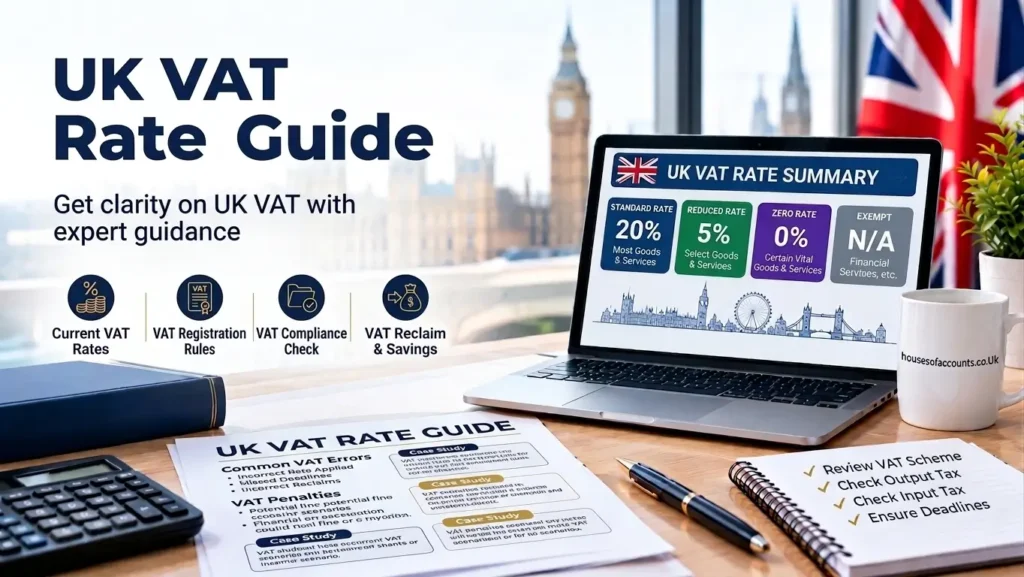
The UK applies three core VAT rates for the 2026/27 tax year. The standard rate of 20% applies to most goods and services, including electronics, clothing, professional services, and restaurant meals. The reduced rate of 5% covers a narrower list, including domestic fuel and power. The zero rate of 0% applies to most food, children’s clothing, books, and public transport — these are still taxable supplies, but charged at 0%.
Zero-Rated vs Exempt: What's the Difference?
This distinction trips up many business owners. Zero-rated supplies remain within the VAT system, meaning the business can still reclaim VAT on related costs. Exempt supplies sit entirely outside VAT — no VAT is charged, but the business also cannot reclaim VAT on costs relating to that exempt activity. Getting this wrong affects how much VAT you can legitimately recover.
VAT Registration Threshold
For 2026/27, UK businesses must register for VAT once their taxable turnover exceeds £90,000 in any rolling 12-month period, and have 30 days to register once the threshold is crossed. The deregistration threshold, if turnover later falls, is £88,000.
How to Pay Your VAT Bill
- File your VAT return through HMRC-recognised, Making Tax Digital-compatible software.
- Pay by Direct Debit for automatic collection shortly after the filing deadline.
- Alternatively pay by online banking, debit card, or bank transfer using your VAT registration number as reference.
- Ensure payment clears by the deadline — usually one calendar month and seven days after the end of your VAT period.
Calculating VAT Correctly
To add VAT to a net price, multiply by 1.20 for the standard rate or 1.05 for the reduced rate. To work backwards from a VAT-inclusive price, divide by the same figures rather than simply subtracting the percentage — a common error that produces the wrong answer. For example, £1,200 gross at standard rate is £1,200 ÷ 1.20 = £1,000 net, not £1,200 × 0.80.
Recent VAT Rate Changes to Know
VAT rules shift more often than many business owners realise. In 2026, domestic electricity moved from the 5% reduced rate to 0% from 1 October under a temporary cost-of-living measure, while domestic gas remained at 5%. A separate temporary 5% rate also applied to children’s meals, tickets, and family attraction admissions between late June and early September 2026. Staying current on these changes — even temporary ones — matters for correct invoicing and VAT return accuracy.
- Domestic electricity: 0% from 1 October 2026 (temporary measure).
- Domestic gas: remains at the 5% reduced rate.
- Always check for time-limited rate changes before assuming a rate that applied last year still applies now.
Temporary rate changes like these are easy to miss if you’re not actively following HMRC updates, and applying an outdated rate on invoices can mean either overcharging customers or underpaying HMRC — both of which create admin headaches to unwind later. Businesses selling across multiple categories, particularly in hospitality and retail, benefit most from having someone actively monitoring these changes on their behalf rather than relying on last year’s assumptions.
If you ever discover you’ve been applying the wrong VAT rate, correcting it sooner rather than later matters — HMRC generally allows corrections without penalty if the error is genuine and disclosed promptly, but the same mistake left uncorrected for an extended period, or repeated across many invoices, can attract far closer scrutiny and a more serious penalty once identified during a routine inspection.
Get Your VAT Right Every Quarter
Classifying sales correctly and filing on time is exactly what our VAT accounting services handle for clients across the UK, so you never have to second-guess which rate applies.
Frequently Asked Questions
The standard UK VAT rate is 20%, with a reduced rate of 5% for specific items and a zero rate of 0% for goods like most food and children's clothing.
Businesses must register once taxable turnover exceeds £90,000 in any rolling 12-month period, with 30 days to register once the threshold is crossed.
To add VAT, multiply the net price by 1.20 (standard rate). To remove VAT from a gross price, divide by 1.20 rather than subtracting 20% directly.
Zero-rated supplies are taxable at 0% and allow VAT recovery on related costs, while exempt supplies are outside VAT entirely and don't allow VAT recovery.
Most VAT-registered businesses pay quarterly, following the same schedule as their VAT return filing, with payment due shortly after the filing deadline.
Yes, and it's the most convenient method, as HMRC automatically collects the amount due shortly after your filing deadline.
Yes. Our accountants review your products and services to ensure the correct VAT rate is applied, reducing the risk of costly misclassification.
Ready to Start?
Don’t let confusing numbers or missed deadlines hold your business back. Get matched with a dedicated ACCA Qualified accountant at House Of Accounts and get clear, upfront pricing from day one.
Get in touch with our team today and let us take the accounting stress off your plate.
Contact Us to Book Your Free Consultation
📞 Call: +44 20 3386 1902
💬 WhatsApp: +44 7539 945628
✉️ Email: Info@housesofaccounts.co.uk
📍 Address: 9 Powick Road, Birmingham, B23 7NY, UK