ACCA Qualified Accountants
9 Powick Road, Birmingham B23 7NY
What Is the 0T Tax Code and Why Did I Get It?
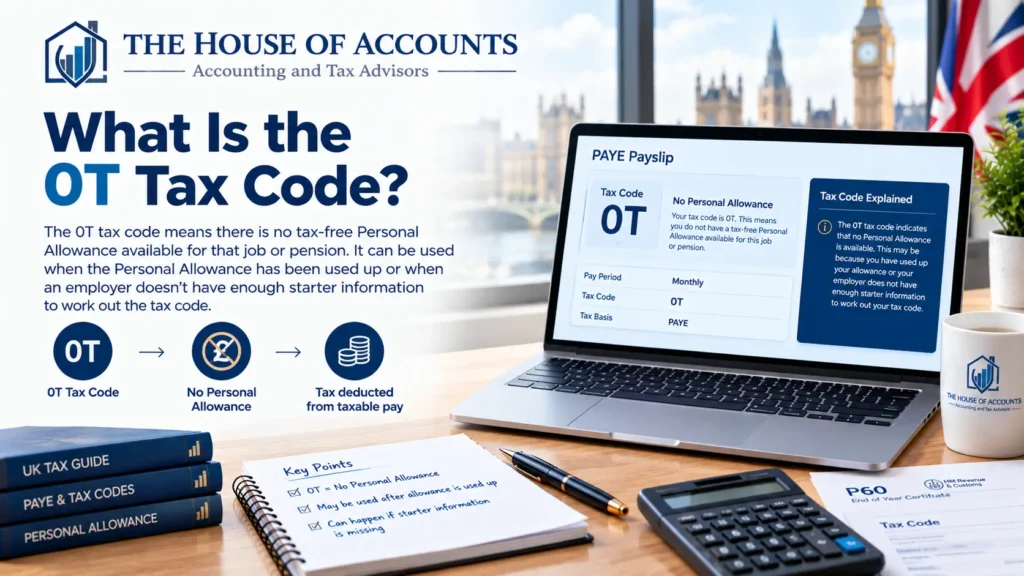
Spotted 0T on your payslip and wondering what it means for your pay? House Of Accounts explains exactly why HMRC assigns this code and, more importantly, how to fix it.
What Does the 0T Tax Code Mean?
The 0T tax code means HMRC has not applied any tax-free Personal Allowance to that source of income — instead of the usual £12,570 being tax-free, every pound you earn is taxed immediately at your applicable rate (20%, 40%, or 45%, depending on your income level).
Why You Might Get a 0T Tax Code
- Starting a new job without giving your employer a P45 or completing a Starter Checklist.
- Having multiple income sources, where your Personal Allowance is already being used against another job or pension.
- Earning above £125,140, where the Personal Allowance is fully withdrawn regardless.
- HMRC not yet having complete or up-to-date information about your employment.
How 0T Differs From an Emergency Tax Code
0T is closely related to emergency tax but is technically distinct — it applies progressive tax bands (20%, 40%, 45%) to your full income with no allowance, whereas a BR code applies a flat 20% regardless of how much you earn. HMRC uses 0T as a cautious holding position while it confirms your correct tax details.
How Much Extra Tax Does 0T Cost You?
On a £30,000 salary, losing the £12,570 Personal Allowance and being taxed on the full amount costs roughly an extra £2,500 a year in Income Tax until the code is corrected — a significant hit to take-home pay, though it’s usually temporary and refundable.
How to Fix a 0T Tax Code
- Give your new employer a P45 from your previous job, if you have one.
- Complete a Starter Checklist with your employer if you don’t have a P45.
- Check and update your details through your HMRC Personal Tax Account online.
- Contact HMRC directly if the code hasn’t corrected itself after a couple of pay periods.
Will I Get a Refund?
Yes. Once HMRC has the correct information and updates your tax code, any tax you overpaid while on 0T is typically refunded automatically through your payroll, or directly by HMRC if the correction happens after the tax year ends.
0T on a Pension Instead of a Job
The 0T code isn’t limited to employment income — it can also appear against a pension, particularly when you start drawing from a new pension provider who doesn’t yet have your correct tax details, or when a pension is your second source of income and your allowance is already applied elsewhere. The same underlying cause applies: HMRC or the provider lacks enough information to apply your correct allowance, so tax is deducted on the full amount until it’s resolved.
- New pension providers may apply 0T until they receive your correct tax code from HMRC.
- If you’re drawing multiple pensions, only one should normally carry your full Personal Allowance.
- The same correction process applies — update your details with the provider or contact HMRC directly.
If you’re managing multiple income sources — a part-time job alongside a pension, for instance — it’s worth proactively telling HMRC about all of them rather than waiting for a 0T code to appear and correct itself. Providing complete information upfront through your Personal Tax Account often prevents the temporary overtaxation altogether, rather than having to claim it back after the fact once the code has already been applied incorrectly for a pay period or two.
Sort Your Tax Code Correctly
If you’re unsure whether you’re on the right tax code, or need help reclaiming overpaid tax, our payroll and tax services can review your position and liaise with HMRC on your behalf.
Frequently Asked Questions
It means you have no tax-free Personal Allowance applied to that income, so tax is deducted from the very first pound you earn.
No, it's almost always temporary, typically corrected within one to three pay periods once HMRC has your correct information.
Provide your employer with a P45 or complete a Starter Checklist, then check your details are correct in your HMRC Personal Tax Account.
Yes. Once your tax code is corrected, any overpaid tax is usually refunded automatically through payroll or directly by HMRC.
0T applies progressive tax bands with no allowance, while BR applies a flat 20% rate regardless of income level — both remove your Personal Allowance.
If your Personal Allowance is already being used against your main job, HMRC may assign 0T to a second job since no allowance remains available for it.
Yes. We can review your tax code, identify the cause of any error, and help correct it with HMRC on your behalf.
Ready to Start?
Don’t let confusing numbers or missed deadlines hold your business back. Get matched with a dedicated ACCA Qualified accountant at House Of Accounts and get clear, upfront pricing from day one.
Get in touch with our team today and let us take the accounting stress off your plate.
Contact Us to Book Your Free Consultation
📞 Call: +44 20 3386 1902
💬 WhatsApp: +44 7539 945628
✉️ Email: Info@housesofaccounts.co.uk
📍 Address: 9 Powick Road, Birmingham, B23 7NY, UK