
To register for VAT, sign in to HMRC’s online registration service on GOV.UK and complete the application. You must register if your taxable turnover was more than £90,000 in the last 12 months, or you expect it to go over £90,000 in the next 30 days. You have 30 days from the end of the month in which you crossed the threshold.
VAT registration is one of the few tax deadlines set by your own sales, not by the calendar. Cross the threshold in a busy month and the clock starts whether you noticed or not. The team at House Of Accounts registers sole traders and limited companies for VAT and files their returns afterwards.
This guide explains how to register for VAT in the order you will need it: when registration becomes compulsory, what to have ready, how to apply online, and what happens while you wait for your number.
When you must register for VAT
You must register if either of two tests is met. Both use the same £90,000 threshold.
The rolling 12-month test
Add up your taxable turnover for the last 12 months at the end of every month, not just at your year end. If the total goes over £90,000, you must register within 30 days of the end of that month. Your effective date of registration, the day you start charging VAT, is the first day of the second month after you went over.
on 20 October 2026 your taxable turnover for the previous 12 months reaches £92,000 for the first time. You must register by 30 November 2026, and your effective date of registration is 1 December 2026.
The next-30-days test
You must also register if you realise your taxable turnover will go over £90,000 in the next 30 days alone, for instance because of one large contract. You have to register by the end of that 30-day period. The effective date is the day you realised, not the day the money arrives.
What counts as taxable turnover
Taxable turnover is the total value of everything you sell that is not VAT exempt or outside the scope of VAT. It includes standard-rated, reduced-rated and zero-rated sales, so zero-rated sales still count towards the £90,000. Our guide to current UK VAT rates shows which rate applies to what. Remember that the test looks at turnover, not profit.
Two exceptions are worth knowing. If you go over the threshold only temporarily, you can apply to HMRC for a registration exception. If most of what you sell is zero-rated, you can ask HMRC for an exemption from registration. HMRC confirms its decision on both in writing.
What you need before you start
The information HMRC asks for depends on the type of business.
| Limited company | Sole trader or partnership |
|---|---|
| Company registration number | National Insurance number |
| Business bank account details | An identity document, such as a passport or driving licence |
| Unique Taxpayer Reference (UTR) | Bank account details |
| Details of your annual turnover | UTR, if you have one |
| Estimated taxable turnover for the next 12 months | Details of your annual turnover |
| Information about Self Assessment, Corporation Tax and PAYE | Estimated taxable turnover for the next 12 months |

How to register for VAT online, step by step
Most businesses register online through GOV.UK.
- Confirm which test you have met and your effective date. Write down the date you crossed £90,000. Everything else follows from it.
- Gather the details listed above. Having them to hand avoids a half-finished application.
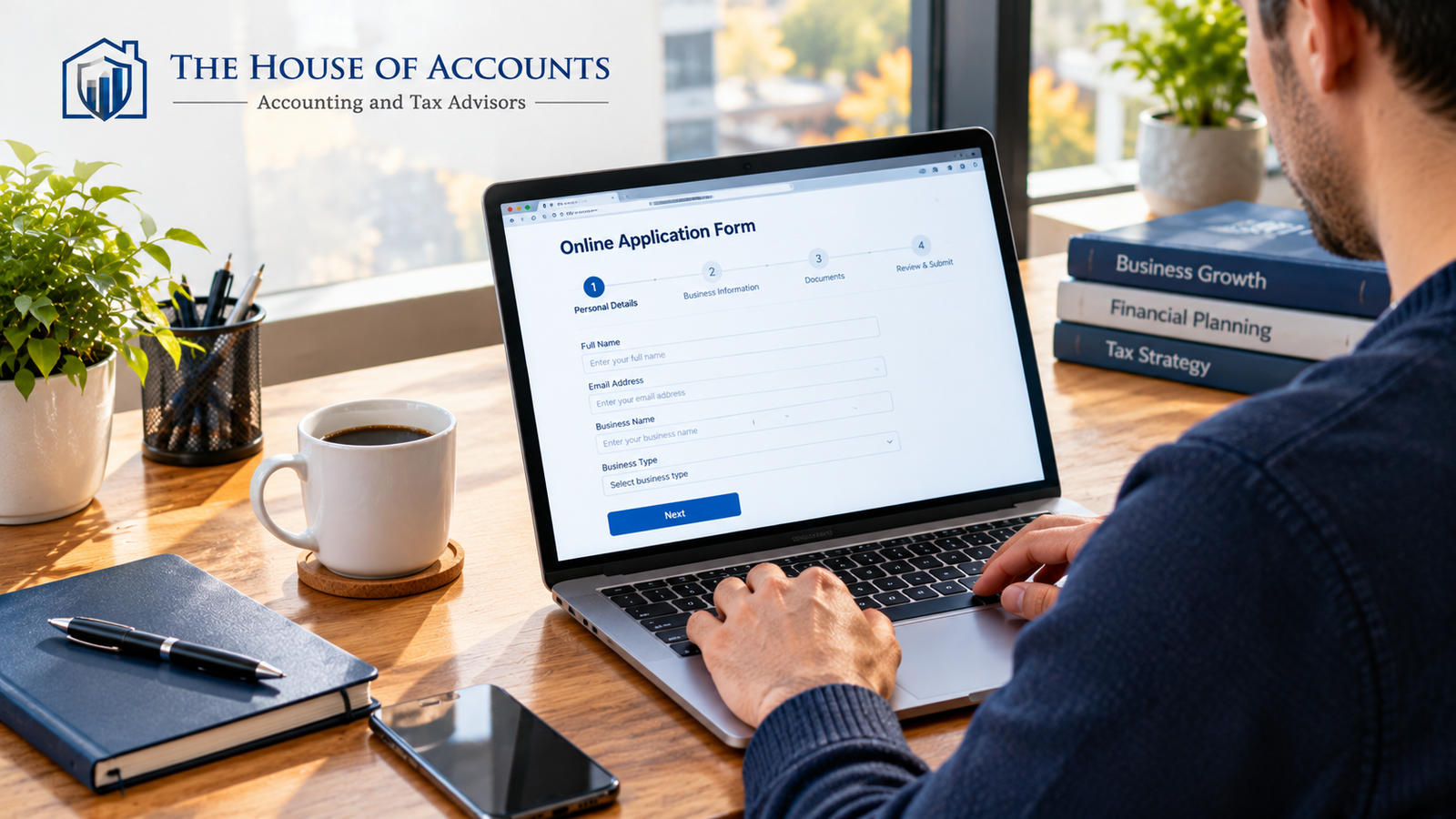
- Sign in to HMRC’s VAT registration service on GOV.UK. If you do not have sign-in details, you create them the first time you sign in.
- Complete the application. You do not have to finish in one sitting: you can save your entry and return to it. Depending on your type of business, HMRC asks for extra forms along the way.
- Submit and wait for HMRC. By post you will receive your 9-digit VAT registration number, confirmation of your effective date of registration, and details of when your first VAT return and payment are due.
- Sign up for a VAT online account as soon as the number arrives. Sign in, select “Add a tax, duty or scheme now”, then “VAT and VAT Services”.
Prefer not to do this yourself? An accountant can register as your agent and deal with HMRC for you. Call 020 3386 1902.
When you must apply by post
A few cases cannot be done online and need form VAT1 instead. They include applying for a registration exception because you went over the threshold temporarily, joining the Agricultural Flat Rate Scheme, and a limited liability partnership registering as the representative member of a VAT group. GOV.UK lists the rest.
How to register for VAT as a sole trader
A sole trader registers through the same online service, as an individual. You will need your National Insurance number, an identity document such as a passport or driving licence, your bank account details, your UTR if you have one, details of your annual turnover, and an estimate of your taxable turnover for the next 12 months. HMRC may also ask for information from your Self Assessment return, payslips or P60.
The threshold and the deadlines are exactly the same as for a company: £90,000 of taxable turnover, and 30 days to register. What changes is the paperwork, because there is no company registration number or Corporation Tax record to give.
How long VAT registration takes
HMRC’s registration pages do not give a fixed number of days. They point to an online tool that tells you when to expect a reply. Plan around your effective date instead, because VAT is due from that date whether or not your number has arrived.
What to do while you wait for your VAT number
You cannot include VAT on your invoices until you have your VAT registration number. You can, however, increase your prices to cover the VAT you will owe HMRC from your effective date. Tell customers why, then reissue the invoices showing the VAT once the number arrives.
you agree a £100,000 contract, tell the customer you are adding 20%, and invoice £120,000. When your number arrives you reissue the invoice showing £20,000 of VAT. The customer pays nothing extra and can reclaim the VAT on their next return.
What happens if you register late
If you register late, you must pay VAT on every sale you have made since the date you should have registered. That VAT is due even if you did not add it to your prices at the time. You may also have to pay a penalty, which depends on how much VAT you owe and how late the registration is. This is why checking the rolling 12-month total every month matters.
After you register: first steps
- Put your 9-digit VAT registration number on every invoice you raise.
- Charge VAT on your sales from your effective date of registration.
- Keep your VAT records digitally. HMRC signs your business up to Making Tax Digital for VAT automatically, unless it is exempt.
- Note the due date of your first return and payment from HMRC’s letter. Our page on filing your first VAT return explains what a return involves.
- Ask your accountant whether a VAT accounting scheme would suit your business.
Should you register before you reach the threshold?
You can. HMRC lets a business with taxable turnover under £90,000 register voluntarily, and you then pay HMRC any VAT you owe from the date it registers you. Whether that helps depends on who your customers are and how much VAT you pay on your own costs.
How House Of Accounts handles your VAT registration
- We check your month-by-month turnover against both tests and confirm your effective date.
- We submit the application as your agent and deal with HMRC’s questions.
- We set up your digital records and prepare your first return.
Fees are quoted after a short scope call, with all costs listed upfront, and one ACCA-qualified accountant looks after you throughout. Our returns are Making Tax Digital-compliant. See our VAT filing service for what is included.
Frequently asked questions
How long does it take to register for VAT?
HMRC’s registration pages do not give a fixed number of days. Your effective date of registration is set by the rules, not by when the paperwork arrives, so VAT is due from that date even while you wait for your number.
Can I charge VAT before I receive my VAT number?
No. You cannot show VAT on invoices until you have the number. You can raise your prices to cover the VAT due from your effective date, then reissue the invoices with VAT shown once the number arrives.
Do I need to register for VAT if I am a new company?
Only if you meet one of the two tests: more than £90,000 of taxable turnover in the last 12 months, or expected in the next 30 days. A new company below that level can still register voluntarily.
How do I calculate my taxable turnover?
Add up everything you sold in the last 12 months that is not VAT exempt or outside the scope of VAT. Include zero-rated and reduced-rated sales. Check the rolling total at the end of each month.
Can an accountant register for VAT on my behalf?
Yes. You can appoint an accountant as your agent to submit VAT returns and deal with HMRC for you. You still sign up for your own VAT online account once you have your registration number.
Close to £90,000, or already over?
Get in touch and we will check your turnover against both tests and submit the application for you. You can also message us on WhatsApp on +44 7539 945628.
This article was researched and drafted with AI assistance, then fact-checked against GOV.UK guidance and edited by the House Of Accounts team.